Healing Childhood Trauma: Why Shame Makes It Hard to See Your Own Progress
I remember standing in a room with someone who had hurt me deeply.
My heart was pounding so hard I could feel it in my throat.
I could not catch my breath. And then I was gone.
Not physically. But mentally and emotionally, I dissociated. My nervous system did what it had learned to do when the threat felt too large to stay present for.
When I came back to myself, the first voice I heard was not compassion. It was shame.
I thought I had left this at the altar. You should be over this by now.
And it was not just internal. It came from church friends, from family, from the quiet message that if my faith were strong enough, this would not still be happening.
For a long time, I believed them.
What I know now is this:
The problem was never that I was not healing.
The problem was that shame was narrating my healing and shame is not a reliable witness.
What Healing Childhood Trauma Actually Looks Like
Most people expect healing from childhood trauma to feel like arrival. Lighter. Freer. Resolved.
They imagine waking up one day and the weight simply being gone. The trigger no longer triggering. The old wound no longer tender. That is not usually how healing works.
Healing is quieter than that. Slower. Easier to miss. It looks like a fraction more space between the trigger and the reaction. It looks like noticing what is happening in your body before you are already in the middle of it. It looks like coming back to yourself a little faster than before.
Healing is not the absence of activation. It is what becomes available to you when activation comes.
But shame intercepts that narrative before you can recognize your own progress and replaces it with a verdict: not enough, not yet, not right.
That is why so many people who are genuinely healing do not know it.
What Are the Stages of Trauma Healing?
Trauma healing does not move in a straight line, follow a schedule, or announce itself clearly. But there are broad movements that tend to unfold, not in order, and often overlapping.
Learning that you are safe enough to feel. The nervous system begins to slow down. Emotions that were frozen begin to surface, and this can feel disorienting. What is actually happening is that your body is finally exhaling, releasing what it could not release while it was still in survival mode. This is something I work through with clients in anxiety counseling, especially when activation feels like it comes from nowhere. This is not regression. This is the beginning.
Beginning to understand your patterns. the links are therYou start recognizing activation earlier and begin to see the roots beneath the reactions. What looks like an overreaction in the present is often connected to a root system formed long ago. Awareness does not automatically change the pattern, but it begins to create space between the pattern and your identity.
Choosing instead of surviving. Emotions begin to function as information rather than verdicts. Boundaries begin to form naturally. You can be in a hard moment and still have some sense of who you are.
You can be in all three of these movements on the same Tuesday. Healing is not linear, and you are not behind if you move back and forth between them. That movement is part of the process.
Not Sure How Deep This Belief Runs?
If you’re wondering whether shame has shaped your identity more than you realized, I created a short Shame Quiz to help you reflect on what may be operating beneath the surface.
It’s not diagnostic. It’s a starting point for awareness.
How Shame and Trauma Reinforce Each Other
Shame and trauma are rarely separate. In most cases, they were formed in the same wound. When painful or unsafe experiences happen, especially in childhood, shame often moves in quietly alongside them. If you grew up in an environment where certain experiences felt normal but were not, you can read more in It Wasn't Normal. It offers an explanation: this happened because something is wrong with me.
That explanation feels like control. And control, even a false version of it, feels safer than helplessness.
But shame does something deeply problematic to the healing process. It keeps the nervous system activated. And an activated nervous system produces more shame.
This means the very tool you would use to assess your own progress, your internal sense of yourself, is being distorted by the thing you are healing from. That is not weakness. That is the nature of the wound.
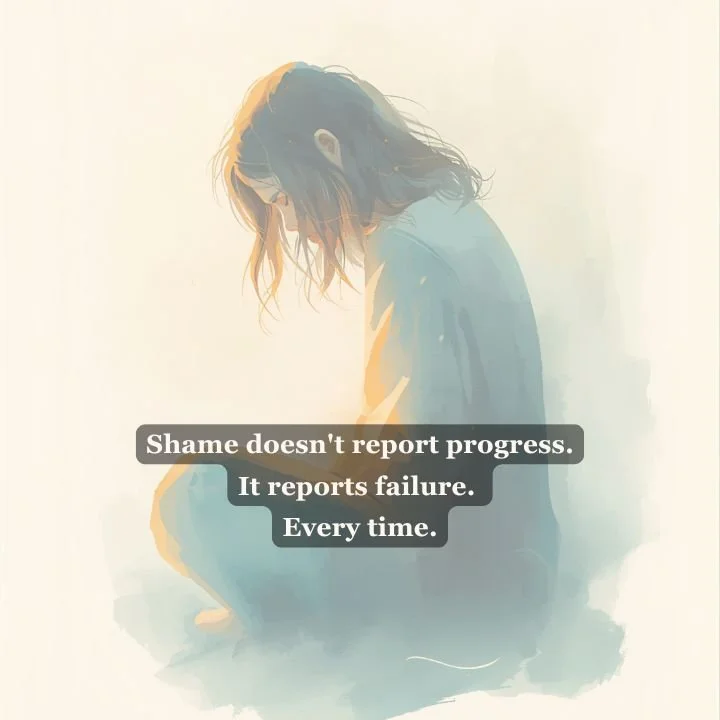
Shame does not report progress. Shame reports failure. Every time.
Four Ways Shame Distorts Your Healing Progress
This is the part no one tells you about healing childhood trauma. Shame does not just make healing painful. It makes healing invisible.
Here are four specific ways it does that.
1. Shame distorts your timeline.
You should be over this by now. Other people heal faster. If therapy were working, you would feel better by now.
Shame turns healing into a performance review and you are always behind schedule.
Healing has no deadline. Your nervous system heals at the pace it feels safe, not the pace shame demands. Pushing harder does not make the roots release faster. Safety does. Compassion does. Time does.
When shame tells you that you are taking too long, that is not truth. That is pressure. And pressure is not the same as progress.
2. Shame distorts your faith walk.
I left this at the altar. Why is it still here? If my faith were stronger, this would not still affect me.
This is one of the most painful distortions, and it is one that church culture can quietly reinforce. The expectation that surrender equals instant transformation. That if you really gave it to God, your body would have gotten the message by now.
Surrendering something to God is real and meaningful. AND your body still needs time to catch up. Faith and nervous system healing are not in competition. They are companions.
Psalm 34:18 does not say God is near to the healed. It says He is near to the brokenhearted. That includes you. In the middle of the process. On the hard Sundays. In the rooms where your heart pounds and your breath disappears.
Your struggle is not evidence of weak faith. It may be evidence that you are doing the most honest and courageous work of your life.
3. Shame distorts your sense of safety.
This one is personal for me. Standing in that room, heart pounding, unable to breathe, dissociating, shame told me I had not forgiven.
What I have since learned is that forgiveness and safety are two entirely separate things. My body's response was not unforgiveness. It was wisdom. It was my nervous system doing exactly what it learned to do in the presence of someone who had caused harm.
But I also want to say something the faith community does not always say clearly enough: Forgiveness is not the same as reconciliation. And reconciliation is not the same as access.
Forgiveness means releasing your right to revenge and choosing to place that person under God's care rather than continuing to carry the weight of the wound yourself. It is something you do for your own healing, not something you do for the other person.
Reconciliation requires safety, accountability, and changed behavior from the other person. It is not automatic. It is not always possible. And it is not always wise.
Access is proximity. Who gets close to you, your time, your home, your heart. Forgiveness does not obligate access.
Learning to be safe in your body is healing. Setting boundaries with your presence, choosing where you sit, how long you stay, who gets close access to you, that is not a failure of faith. It is the fruit of it.
Your nervous system reacting in the presence of someone who caused harm is not proof you have not forgiven. It is your body doing exactly what it learned to do to keep you safe. Shame will tell you those two things are the same. They are not.
4. Shame distorts your identity.
This is the deepest root. Shame does not just distort what you think about your progress. It distorts what you think about yourself. It moves quietly from I did something bad all the way down to I am bad.
And once it reaches identity, it rewrites everything. It shapes how you read Scripture. It shapes how you receive love. It shapes whether you believe healing is even available to you.
When shame is operating at the identity level, you do not just feel behind in your healing. You feel like someone who does not deserve to heal. Someone too broken. Too far gone. Too much and not enough at the same time.
If that belief feels familiar, you may want to read Why Do I Feel Unlovable? where we go deeper into how shame becomes fused with identity and what healing at that level can look like.
But shame is not telling the truth about who you are.
Psalm 139 says you are fully known and fully loved. Not loved once you improve. Not accepted once you heal. Known. Now. As you are. In the middle of the process, with the roots still tangled and the activation still real.
Your worth was never up for negotiation. Shame just convinced you it was.
What Healing Actually Feels Like: A Closer Look
Because shame keeps healing invisible, it helps to know specifically what to look for. These are some of the real signs you are healing from childhood trauma, even when shame says otherwise.
It feels like noticing. Your heart starts pounding. Your chest tightens. And instead of being swept away by it, something in you observes it: Something is happening in my body right now. That pause is healing.
It feels like checking in instead of checking out. Instead of dissociating, numbing, or running, you pause. You ask yourself what you need. You give yourself a moment before you respond. For someone who spent years in survival mode, that pause is profound.
It feels like emotions becoming information. You feel the anxiety, the flood, the tightening and instead of believing it as final verdict, you get curious. What is this telling me? What might I be trying to protect? Then you look at the facts and choose your response. Emotions are indicators. They are not sentences.
It feels like boundaries becoming natural. You give yourself permission to sit across the room. To leave early. To limit your presence at the family gathering. Not because you have not forgiven. But because you are learning to be safe in your body and that is allowed.
It feels like faster recovery. You still get activated. But you come back a little faster than you did before. Shame will not point that out to you. But that shorter recovery time is one of the clearest signs that healing is happening.
It feels like hearing the shame voice without automatically believing it. You notice the voice, you should be over this, your faith is weak, something is wrong with you, and something in you does not fully collapse into it. You can hear it and question it. That distance, however small, is healing.
Healing Steps: How to See Your Progress When Shame Tries to Hide It
Shame has a selective memory. It catalogues every setback and erases every step forward. These healing steps are designed to counter that directly.
Notice the shame voice and name it out loud.
Shame thrives in secrecy and silence. It loses power when it is named. When you hear you should be over this or your faith must be weak, try saying it out loud, to yourself, to your therapist, to a trusted friend. Not to agree with it. To externalize it. To get it out of the interior where it operates unchecked and into the light where it can be examined. You do not have to argue with shame. You simply have to stop letting it narrate in the dark.
Keep a small wins record.
At the end of each day, write down one moment where you responded differently than you used to, even slightly. You paused before reacting. You named what you were feeling. You asked for what you needed. You left a situation that did not feel safe. These are evidence of healing. And shame will erase them if you do not record them.
Ask a different question after activation.
Old question (shame): What is wrong with me? New question (healing): What was my body trying to protect me from? This single shift moves you from self-condemnation into self-understanding. It does not make the activation comfortable. But it begins to change the story you tell about yourself afterward.
Separate your body's response from your spiritual identity.
When your nervous system responds, heart pounding, breath gone, dissociation, practice pausing before you assign spiritual meaning to it. Your body responding to someone who hurt you is not unforgiveness. Your anxiety surfacing in worship is not weak faith. Try saying this: This is my nervous system doing its job. This is not a verdict on my character or my faith.
Let trusted people reflect your progress back to you.
Shame is loudest in isolation. One of the most powerful things you can do is ask a therapist, a trusted friend, or a mentor: Do you see growth in me that I might be missing? You do not have to take their answer as final truth. But you can let it be a data point that shame does not get to erase.
Mark your healing with intention.
In Scripture, the Israelites built altars, not only to worship, but to remember. This is where God met me. This is where something shifted. Consider marking your own healing moments with intention. A journal entry. A prayer. A conversation. Not because healing is complete. But because your progress deserves a witness, even if that witness is only you.
If shame has been narrating your healing story, it may be time to get a second opinion.
The Shame Quiz is a gentle starting place, a way to begin to see what shame may be hiding from you, including your own progress.
Is shame impacting your ability to feel loved?
Does Struggling During Healing Mean Something Is Wrong With My Faith?
No. It does not.
Struggling during healing is not spiritual failure. It is often the evidence that you are doing the most honest and courageous work of your life.
The altar moment is real. Surrendering something to God matters. AND the body still needs time to learn what the spirit has already received. Faith does not override the nervous system. It walks alongside it.
God does not grade healing on a timeline. He is not watching your progress and growing impatient. Romans 8:38-39 reminds us that nothing separates us from His love. Not our trauma. Not our slow healing. Not our activation on a Sunday morning. Not the roots that are still tangled.
Faith and therapy are companions on the same journey toward wholeness. Faith offers meaning, hope, and grace. Therapy helps untangle the emotional and nervous system patterns that make healing hard to feel and hard to see. One does not replace the other.
You are not behind. You are not failing. You are not too broken, too far gone, or too much. You may simply be healing in ways shame has not allowed you to see yet.
The roots run deep. But roots can be understood. And understood roots can be gently, steadily untangled.
If you are ready for support that integrates nervous system healing with compassionate, faith informed care, I offer trauma counseling for adults navigating exactly this. I would be honored to walk that with you.
Schedule a free consultation to see if it feels like a good fit.
Healing does not require rushing.
It requires a safe place to begin.
📍 Eleanor Brown, MA, LPC — faith-based therapist in Central Texas
💻 Serving clients across Killeen, Texas and Miami, Florida via telehealth