Why Do I Feel Unlovable?
There is a kind of ache that does not always look dramatic.
It can show up after rejection.
After conflict.
After silence from someone you love.
But sometimes it shows up on an ordinary Tuesday afternoon.
You are going about your day and a quiet thought slips in:
Why do I feel unlovable?
Why does it feel like nothing I do is ever enough?
Why does there always seem to be something wrong with me?
Why does connection feel just out of reach?
For some people, the feeling is loud and spiraling.
For others, it is quiet and numb.
For others still, it explodes out of nowhere when they are emotionally activated.
It can feel like a pit in your stomach.
Like a contamination you cannot wash off.
Like proof that you are somehow fundamentally flawed.
If you have ever created conflict just to confirm what you already feared,
you are not alone.
And you are not broken.
But there may be roots beneath this belief that are deeper than you realize.
What’s Growing in Your Garden?
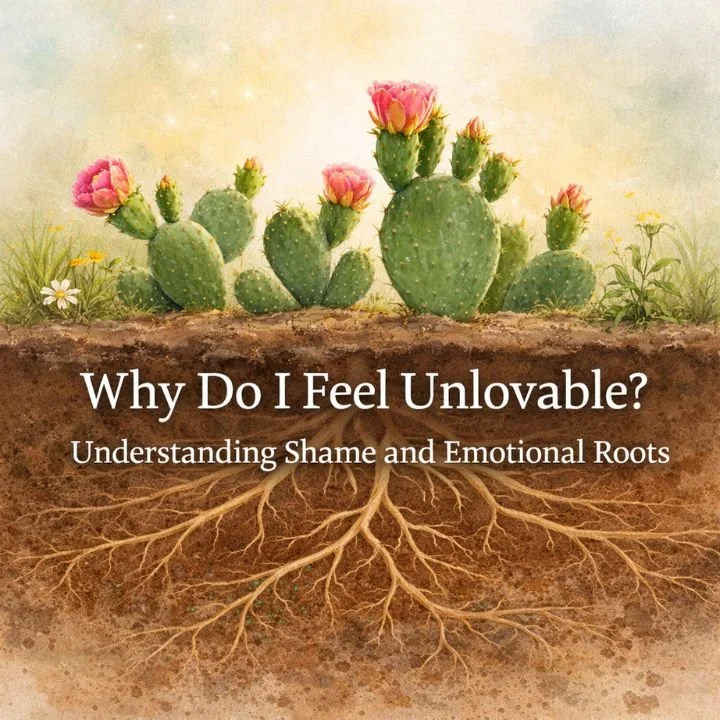
A few years ago, my husband and I were driving home when we passed a neighbor’s house with cactus planted in the front yard. They had been trying to get rid of it for years. No matter how many times they cut it down, it kept coming back.
I told my husband about some land I had worked on many years earlier. When I was clearing cactus on that property, I noticed something I hadn’t paid much attention to before. You could see cactus shoots hundreds of yards apart.
We didn’t realize those shoots were connected until we started digging them up.
The roots ran deep. Long. Wide.
Far beyond what was visible.
You might not even know the root system is there until something catches on it.
That’s when I realized something important.
Shame can work the same way.
Sometimes it spreads like weeds, obvious, and fast.
You see it in over apologizing.
People pleasing.
Trying to earn approval.
Shrinking yourself so others stay.
You work on those patterns, build boundaries, and grow in confidence.
And that work matters.
Other times, shame is more like cactus.
It may look contained.
Manageable.
Even healed.
Until stress hits.
Conflict happens.
Someone seems distant.
And suddenly something sharp rises inside you.
Not because it just appeared.
But because the root system has been there for a long time.
So the question becomes:
What’s growing in your garden?
What Causes the Core Belief of Being Unlovable?
Shame at its deepest level is not just feeling bad about what you did. It is believing something is wrong with who you are. Shame rarely operates in isolation. It tends to follow predictable cycles, especially in relationships.
The belief that you are unlovable rarely begins as a loud statement.
It begins quietly.
It forms in moments where love felt conditional.
Where connection was inconsistent.
Where approval had to be earned.
Where trauma, neglect, betrayal, or criticism shaped your sense of safety.
Over time, your nervous system adapts.
You learn how to prevent rejection.
How to keep love close.
How to minimize conflict.
Those adaptations can look like:
Being constantly on alert
Trying to fix problems before they grow
Anticipating other people’s needs
Monitoring tone and subtle shifts
On the surface, they look like personality traits. Underneath, they are protection strategies.
When protective strategies become fused with identity, something shifts.
Instead of, “I learned to cope this way,” the belief slowly becomes, “There must be something wrong with me.” Over time, behavior turns into belief.
That’s how weeds become roots.
And that’s how roots begin to define how you see yourself.
Signs You May Be Living With the Belief That You’re Unlovable
You may not walk around saying, “I am unlovable.”
It often sounds more subtle than that.
You might notice:
You feel responsible for other people’s emotions.
You replay conversations long after they end.
You apologize quickly, even when you are not sure you did anything wrong.
You feel uneasy when someone pulls away, even slightly.
You assume distance means you did something.
You try to prove your worth through performance, productivity, or perfection.
You create conflict when you feel insecure, almost to confirm what you already fear.
You struggle to fully relax into love, even when someone is kind.
Many people I work with do not realize they carry this belief until something small emotionally activates them.
A look.
A tone shift.
A forgotten text.
A stressful week.
And suddenly it feels bigger than the moment.
If you see yourself in this list, this is not proof that you are broken.
It may simply mean a root system formed somewhere along the way.
And roots can be understood.
Not Sure How Deep This Belief Runs?
If you’re wondering whether shame has shaped your identity more than you realized, I created a short Shame Quiz to help you reflect on what may be operating beneath the surface.
It’s not diagnostic.
It’s a starting point for awareness.
Take the Shame Quiz here.
Why Does It Feel So Intense When I’m Emotionally Activated?
Sometimes people describe these moments as being “triggered.”
And in some cases, that word fits.
A true trigger is when something in the present reactivates stored trauma in the body. It can feel like you are suddenly back in an old memory. Your heart races. Your chest tightens. Logic disappears.
But many of the moments we experience in relationships are better described as emotional activation or feeling uncomfortable.
Emotional activation happens when something brushes against an old root. This is often when the cactus gets bumped.
You are not reliving the past.
But your nervous system remembers it.
If you experienced emotional neglect…
If love was inconsistent…
If approval had to be earned…
If you endured abuse, betrayal, or chronic criticism…
Your nervous system learned something about safety and connection.
It may have learned:
Love is fragile.
I must earn it.
If something goes wrong, it’s my fault.
If I am fully seen, I will be rejected.
Those beliefs do not form because you are weak. They form because you adapted.
Why Do I Sometimes Create Conflict or Push Love Away?
If you carry the belief that you are unlovable, connection can feel risky.
Even when you deeply want it.
Part of you may long to be fully seen.
Another part may brace for disappointment.
So without realizing it, you may begin to test love.
You might withdraw first to see if someone notices.
You might escalate a small issue to see if they stay.
You might pull away emotionally before they have the chance to leave.
You might create conflict when you feel insecure, almost to confirm what you already fear.
Not because you enjoy chaos.
But because uncertainty feels unbearable.
If I already believe I am unlovable,
then proving it can feel strangely safer than hoping it is not true.
This is not manipulation in the way shame might accuse you.
It is protection.
It is your nervous system trying to avoid the shock of rejection.
For some, this looks like clinging tightly.
For others, it looks like distancing and independence.
For others, it swings back and forth between both.
Underneath all of it is the same question:
“Will you still choose me if you see all of me?”
When you understand this pattern, something important shifts.
You move from:
“What is wrong with me?”
to
“What am I trying to protect?”
And that is where healing begins.
Does Feeling Unlovable Mean I Lack Faith?
Many people quietly wonder if feeling unlovable means they lack faith. They may find themselves asking questions like these:
If my faith were stronger, would I feel more secure?
If I trusted God more, would this struggle go away?
Is God disappointed in me for still wrestling with this?
Struggling with shame does not mean your faith is weak.
It means you are human.
It means you have a history.
It means your nervous system learned how to survive something painful.
And emotions themselves are not the problem.
God created emotions.
They are signals, not sins.
But emotions are not always facts.
When shame rises, it can feel true.
It can feel convincing.
It can feel like proof.
But feelings often reflect past wounds, not present truth.
That’s why identity matters.
Psalm 139 reminds us that you are fully known and still fully seen by God.
Not partially known.
Not loved once you improve.
Not accepted once you heal.
Known.
And loved.
Romans 8 reminds us that nothing can separate you from the love of God not failure, not trauma, not insecurity, not even the parts of you that still feel tangled in shame.
When you know who you are and whose you are, something steadies inside you.
Not because emotions disappear.
But because truth anchors you when emotions fluctuate.
Your nervous system may react.
Your history may echo.
But your worth was never up for negotiation.
Wrestling with shame is not spiritual failure.
Sometimes it is the work of bringing your feelings into alignment with truth.
How Do I Begin Healing the Root of Feeling Unlovable?
If you have been carrying the belief that you are unlovable, it makes sense that you are tired.
It is exhausting to measure yourself constantly.
To brace for disappointment.
To question whether you are too much or not enough.
Nothing about this struggle means you are weak.
In many cases, it means you adapted to survive something painful.
Your nervous system learned to protect you.
Your heart learned to scan for danger.
Your mind tried to make sense of rejection.
That is not failure.
That is protection.
But protection does not have to become a permanent identity.
The belief “I am unlovable” was formed in context.
Which means it can also be healed in context.
Not through force.
Not through pretending.
Not through spiritual bypass.
But through steady, intentional work.
Moving Forward with Healing Steps
Moving forward and growing into a healthier version of yourself requires time. Here are some healing steps to start you on your journey.
Notice the pattern without judgment.
When you feel the spiral, the shutdown, or the urge to create conflict, pause. Instead of asking, “What is wrong with me?” ask, “What might I be trying to protect right now?”Name what feels unsafe or emotionally activated.
Is it fear of rejection? Fear of being exposed? Fear of not being enough? Naming it helps your nervous system slow down.Practice one small corrective experience.
Stay in the conversation instead of withdrawing.
Express one honest need.
Allow someone to reassure you without arguing with it.
Small experiences of safety begin to loosen deep roots.
Healing identity-level shame takes time.
But roots can be understood.
And understood roots can be gently untangled.
If this belief has shaped your relationships, your faith, or your sense of self, you do not have to untangle it alone.
In my work at Eleanor Brown Counseling, I help individuals untangle shame patterns and identity wounds with steadiness and compassion. We explore attachment, trauma, and the ways shame has shaped your story. We do not rush the process. We build safety first.
Because when you begin to know who you are and whose you are from a grounded place, something changes.
Not overnight.
But deeply.
You are not broken.
You are patterned.
And patterns can be healed.
Is shame impacting your ability to feel loved?
📍 Eleanor Brown, MA, LPC — faith-based therapist in Central Texas
💻 Serving clients across Killeen, Texas and Miami, Florida via telehealth