Can’t Relax? Five Reasons You’re Stuck in Survival Mode
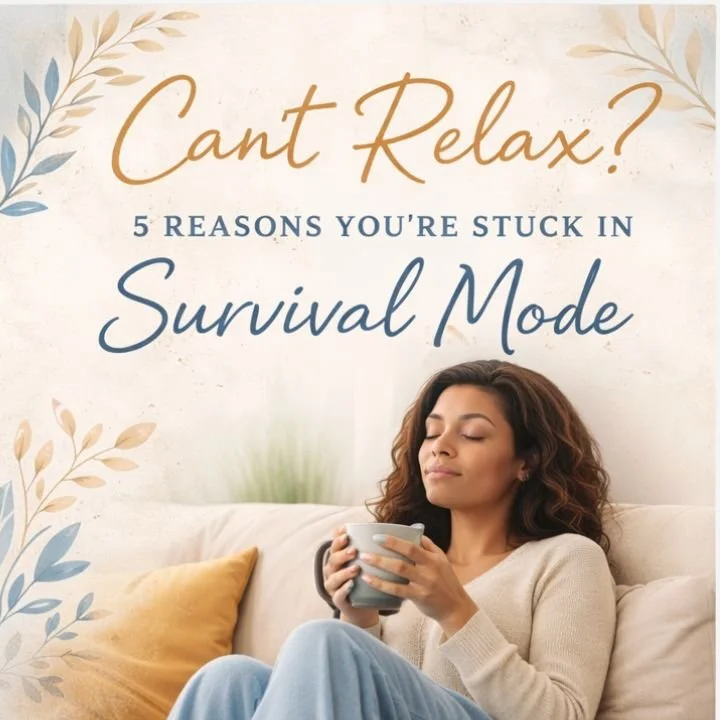
This weekend I planned a day of rest. I sat down with my coffee to relax and start the day ‘gently.’ As I looked around, scanning the room, I thought, I should put this one thing away… oh, let me take care of this real quick… and maybe I should finish the task I got sidetracked on yesterday. Before I knew it, two hours had passed and so had my ‘gentle’ start to the day! The thought that I often have in moments like this is, “Why can’t I relax?”
I’ve lived that way for a long time. For years, I believed rest had to be earned. That if I slowed down before everything was done, something bad might happen or I was being irresponsible. I would be left thinking I was defective somehow. After all, other people can relax! What I have learned, though, is that this was not a personality flaw at all. It was something very different.
It’s often a nervous system response. If you find yourself constantly tense, on edge, or unable to settle even when things seem “fine,” your body may be stuck in survival mode.
Let’s talk about why.
What Does It Mean When You Can’t Relax?
When people struggle to relax, they often assume something is wrong with them. But in many cases, the body has simply learned that staying alert is what keeps it safe.
Long term stress, unmet needs, and early experiences shape how our nervous system responds to the world. Over time, your body may begin to associate calm with danger and busyness with safety. This remains true even if that no longer makes sense in your current life.
That’s not weakness. That’s adaptation.
Five Reasons You May Be Stuck in Survival Mode
1. Your Body Learned to Stay Alert to Stay Safe
If you grew up in an environment that felt unpredictable, emotionally, financially, or relationally, your nervous system likely learned to stay on guard.
You may not have known:
What kind of mood someone would come home in
Whether conflict was brewing
Whether resources would be enough
So your body learned to monitor everything. This kind of hypervigilance doesn’t require a single traumatic event. It can develop simply from not knowing what to expect and needing to adjust yourself to keep the peace.
Your body wasn’t being dramatic. It was being protective. This is something I often explore with clients in trauma counseling, especially when early experiences shaped the nervous system to stay on high alert.
2. Chronic Stress Reset Your Baseline
When stress lasts a long time, it stops feeling like stress. The stress starts to feel like a normal part of life.
For some people, calm actually feels uncomfortable because it’s unfamiliar. Being busy, productive, or constantly “on” becomes the place where they feel most regulated.
The problem is that chronic stress keeps cortisol levels elevated and prevents the body from restoring itself. Over time, this can impact sleep, mood, blood pressure, weight, and emotional resilience.
From a foundational perspective, this connects directly to Maslow’s hierarchy of needs. Physical and emotional safety, including rest, must be in place before deeper healing can occur. When those needs aren’t consistently met, the nervous system stays braced.
Chronic stress rarely exists on its own. Over time, many people begin to internalize the belief that they should be handling things better, coping better, or feeling better by now. That quiet internal pressure can turn into shame, especially when rest feels out of reach.

Curious about the role shame may be playing?
Could shame be holding you back?
Take this free quiz and find out today!
3. Rest Doesn’t Feel Safe Yet
For some people, slowing down doesn’t bring relief. Slowing down brings anxiety.
Silence can feel loud. Stillness can feel dangerous.
When you stop moving, your body finally has space to notice how much stress it’s been carrying. That can feel overwhelming, so your system pulls you back into motion.
I often explain this using a simple analogy: imagine you start the day with a dollar. Every task costs something. Rest is how you earn money back. When rest does not happen, you do not just end the day spent. You start the next day already in deficit.
Over time, your body learns to survive by spending energy, not restoring it.
4. Your Nervous System Is Carrying Unreleased Energy
When the body moves into fight or flight, it’s designed to complete that response.
In nature, animals run, shake, and then settle. Humans, however, often stay stuck in activation. While the threat passes, the energy doesn’t discharge.
This is why deep breathing alone doesn’t always help. Breathing is regulating, but it doesn’t always release stored stress. Gentle movement, intentional physical release, and nervous system completion are often needed to help the body feel safe enough to relax again.
If you’ve ever thought, “Why am I still anxious even when I know I’m okay?”, this may be why. When anxiety feels constant or disconnected from present day stress, anxiety counseling can help make sense of what the body is holding and how to release it safely.
5. You’ve Been Functioning in Survival Mode for a Long Time
Survival mode can become familiar. It can even feel productive or responsible. But unwinding from it takes time.
Healing doesn’t happen through forcing yourself to relax. It happens through small, consistent steps that teach the body safety over time.
I’ve learned this personally. As my life became safer and my relationships more secure, my nervous system slowly followed. It did not happen all at once. It happened gradually.
Slow growth is still growth.
Survival mode often develops during seasons when slowing down was not an option. When safety depended on staying alert, productive, or emotionally guarded, the nervous system learned that rest could wait. Healing does not erase that learning overnight. It gently updates it.
Why This Doesn’t Mean You Lack Faith
Here’s something important to say clearly:
Your nervous system does not measure your faith.
Anxiety, stress responses, and survival mode are not indicators of spiritual failure. God designed your body with protective systems. Having them does not mean you’re doing something wrong.
Faith and healing are not opposites. Prayer was never meant to replace emotional expression or nervous system care.
In Scripture, lament often comes before peace. Honesty comes before restoration. Support, including wise counsel, is part of the design.
Struggle and faith can coexist.
Moving Forward With Compassion
If you can’t relax, your body isn’t broken. It’s asking for safety, patience, and care.
Small steps matter. Support matters. Understanding what your body has been doing for you, not against you, changes everything.
Healing doesn’t require forcing calm. It begins with compassion.
If you would like to learn more about how I approach therapy and whole person healing, you can read more about my practice here.
📍 Eleanor Brown, MA, LPC — faith-based therapist in Central Texas
💻 Serving clients across Killeen, Texas and Miami, Florida via telehealth